
4 min read ·
What England’s Court Counts Actually Show About Padel
England records tennis losses at some padel venues, but net court totals cannot reveal how many direct conversions drove the sport’s rapid expansion.
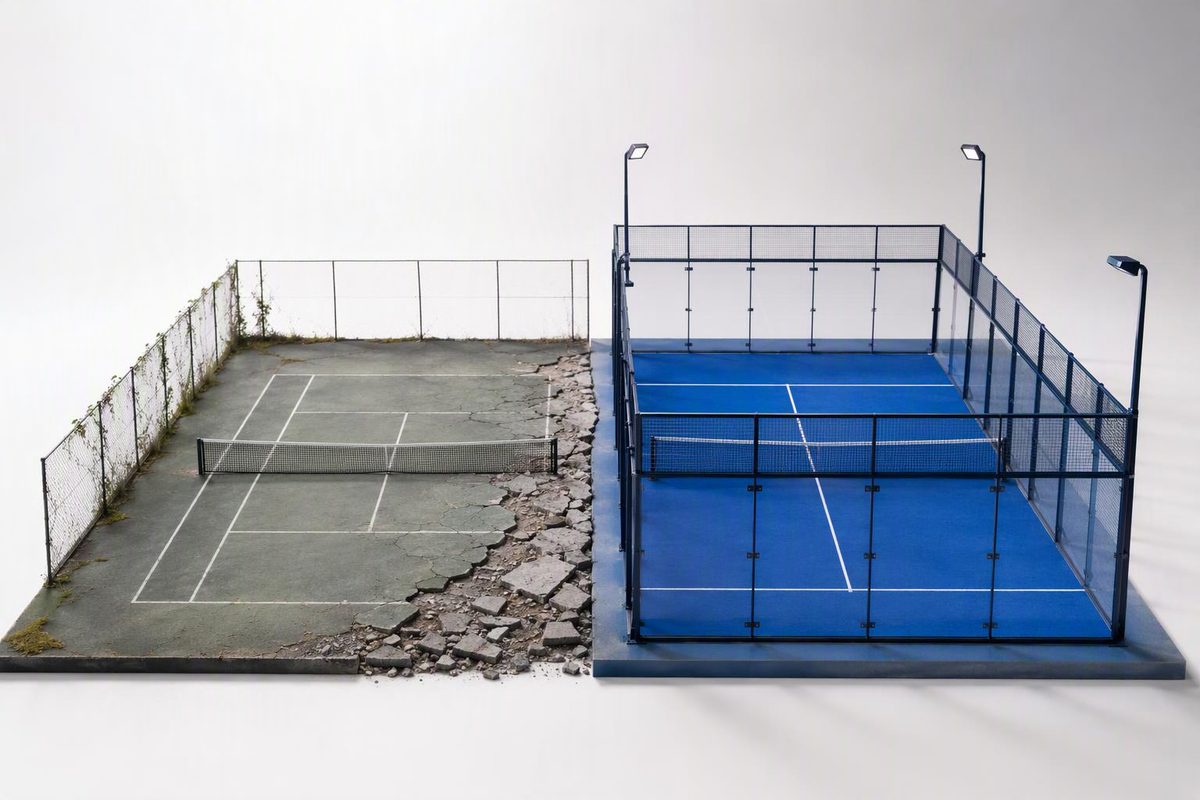
Some tennis courts are being replaced by padel courts, but the available national figures do not show wholesale replacement—or reveal what share of padel growth comes from direct conversions.
Enter comparable net counts; the result shows what the ratio can—and cannot—prove.
National Net-Count Check
These are simultaneous net changes. The ratio does not identify direct conversions.
Change the venue-linked tennis loss
This comparison is not a direct-conversion percentage. Gross closures, openings and padel additions at those venues are not reported by the national net totals.
Source: Guardian analysis of live Sport England facility data, 6 September 2026. England defaults: 183, 382, more than 2,200 and 77.
The clearest recent evidence is from England. Between 2023 and September 2026, the recorded number of tennis courts fell by 183 while padel courts rose from 382 to more than 2,200. At venues that added padel, there was a net loss of 77 tennis courts, according to a Guardian analysis of Sport England data. The underlying facilities database is live, so historical totals can change when venues update their records (The Guardian, 6 September 2026).
What England’s Figures Establish
| Measure | Recorded change since 2023 | What it shows |
|---|---|---|
| Tennis courts in England | Net loss of 183 | The recorded national stock declined slightly |
| Padel courts in England | From 382 to more than 2,200 | Padel supply grew rapidly |
| Tennis courts at venues adding padel | Net loss of 77 | Some padel development is associated with tennis displacement |
The 77-court net loss is about 42% of England’s overall decline of 183 tennis courts. It should not, however, be described as “77 tennis courts converted into padel courts.”
A venue might remove two tennis courts, build several padel courts and add a new tennis court elsewhere on the site. Another might put padel on spare land while retiring an unrelated, unplayable tennis court. A net venue count records the change in tennis supply, not each project’s construction sequence.
The same limitation prevents a stronger claim in the other direction. Comparing more than 1,800 additional padel courts with a net loss of 77 tennis courts does not prove that nearly all padel courts were built away from tennis space. The data does not say how many padel courts opened at the affected venues or how many gross tennis closures and openings sit behind the net figure.
What the figures establish is that replacement exists within a much larger expansion of padel supply. Tennis also remains the larger court network: in September 2026, England had roughly 11 tennis courts for every padel court, and the 183-court decline was less than 1% of the tennis stock (The Guardian).
Padel Development Uses Several Types of Space
Olly Scadgell, the LTA’s managing director of tennis and padel development, said in 2025 that tennis clubs commonly developed padel on spare land, underused tennis courts or courts requiring refurbishment. He distinguished those projects from conversions of scarce indoor tennis courts, which the governing body wanted to avoid (The Guardian, 29 June 2025).
In September 2026, the LTA told the Guardian that tennis courts replaced by padel represented 0.3% of England’s tennis stock. It said most displaced courts were underused, poor or unplayable. That condition assessment is the governing body’s account; it is not a condition category reported in the headline Sport England totals.
Conversion also involves more than installing an enclosure on an existing surface. The LTA’s construction guidance specifies a 20 × 10 metre playing area, site-specific foundations and drainage, and formal planning consent. Noise, lighting, access and ground conditions can determine whether a site works (LTA construction guidance, 2025). Our padel court construction guide covers those constraints in detail.
Local Conversions Can Matter Despite a Small National Share
Lee Valley Hockey and Tennis Centre illustrates why a small national percentage can conceal a substantial local dispute. Its operator proposed replacing four indoor tennis courts with nine padel courts in 2025. After opposition, the authority decided not to proceed and instead announced a wider assessment of tennis and padel options at the site (Lee Valley Regional Park Authority, 31 July 2025; BBC News).
The proposal did not ultimately remove those courts, but it shows why court quality and local scarcity matter. Losing an underused outdoor court in poor condition is not equivalent to losing heavily used indoor or accessible provision.
For an individual project, the relevant questions are:
- Is the tennis court playable, and how heavily is it booked at peak times?
- Is it the area’s only indoor or accessible tennis provision?
- Could padel be built on spare land instead?
- How many playable courts of each type will remain?
- Will prices, community access or bookable hours change?
England’s planning framework does not automatically prohibit changing one sport to another. National guidance says existing sports land should not be built on unless it is shown to be surplus, replaced by equivalent or better provision, or the benefits of alternative sports provision clearly outweigh the loss. Local need and facility quality therefore form part of the decision (Sport England).
Court Loss Does Not Establish Participation Decline
Facility counts and player counts answer different questions. The LTA reported that annual adult tennis participation in Britain reached a record 5.8 million in summer 2025. It also reported that padel participation doubled during 2025 to 860,000 and subsequently passed one million.
By the end of 2025, Britain had more than 1,500 padel courts, while a government- and LTA-funded programme had renovated more than 3,000 park tennis courts (LTA 2025 annual report summary).
The defensible finding is narrow: padel has displaced some tennis courts in England, yet current national net counts cannot identify the exact number of direct conversions or the proportion of padel growth they supplied. An individual conversion should be judged from site plans, court condition, use and remaining local provision—not from either sport’s national growth rate.