
3 min read ·
Epic Padel Milwaukee has eight indoor courts and 32 standard doubles positions
Epic Padel Milwaukee has eight indoor courts, equal to 32 simultaneous doubles positions—not 32 total guests or a published building occupancy limit.
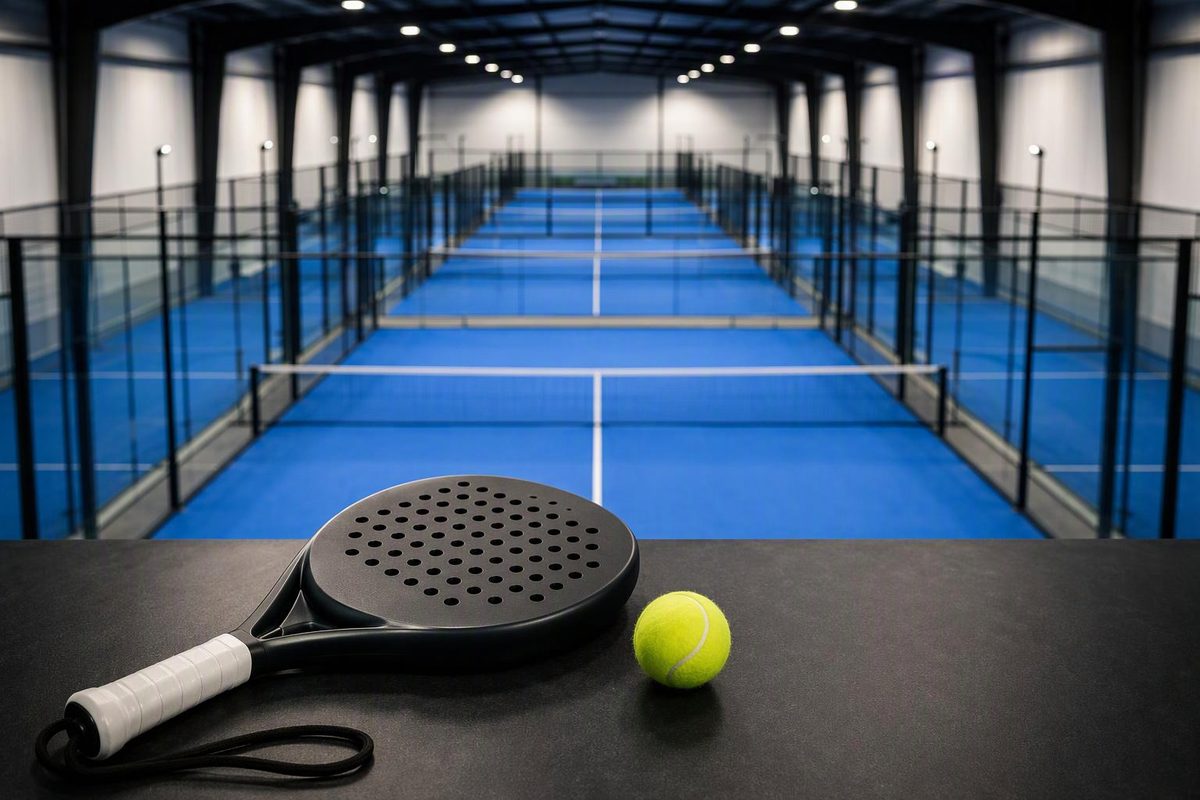
Epic Padel Milwaukee has eight indoor padel courts. Under the standard match format—two pairs on opposite sides of the net, as set out in the International Padel Federation rules—that provides 32 simultaneous playing positions: eight courts multiplied by four players.
That is the useful answer to the club’s on-court capacity. It is not the same as its fire-code occupancy, membership limit or number of people who can use the building in a day.
Capacity at a glance
| Measure | Figure | What it means |
|---|---|---|
| Indoor padel courts | 8 | Installed playing inventory |
| Players per standard doubles match | 4 | Two pairs per court |
| Simultaneous doubles positions | 32 | Four players on each of eight courts |
| Court bookings per time block | 8 | One booking on every court |
| Player-session slots over 12 hours, with 60-minute sessions | 384 | Assumes every court is full for every session |
| Player-session slots over 12 hours, with 90-minute sessions | 256 | Same full-utilization assumption |
The last two figures are theoretical throughput scenarios, not reported attendance or unique-player counts. They assume four players per court, immediate turnover and 100% booking occupancy. The same person playing twice would occupy two player-session slots. Lessons, maintenance gaps, late starts, cancellations and sessions with fewer than four players would reduce actual throughput.
Epic’s Milwaukee location page lists the eight indoor courts at 12320 W Brown Deer Road, along with a warm-up area, locker rooms and showers, a lounge, coworking stations and grab-and-go food service. BizTimes reported on September 23, 2026, that the club had officially launched and described it as an eight-court indoor facility.
What the eight-court figure does not establish
The cited operator, local-news and zoning materials do not state a numerical maximum occupancy for the entire venue. The 32-position calculation covers standard doubles play, while the building can also contain coaches, staff, spectators and visitors using its other spaces.
The Milwaukee Board of Zoning Appeals minutes show that Epic Padel received special-use approval to occupy part of the premises as an indoor recreational facility. The approval required an occupancy certificate and compliance with building and zoning rules, but the minutes do not give a permitted headcount.
Nor does a count of eight courts reveal:
- how many members the club has or will accept;
- how many unique players attend each day;
- how much court time is reserved for lessons, leagues or events;
- peak-time availability; or
- paid utilization.
Those require booking and attendance records. Court count measures physical supply; utilization measures how much of that supply players actually use. The formulas in our peak-time occupancy guide could be applied to the club, but Epic has not published the Milwaukee booking totals needed to calculate a utilization rate.
Milwaukee opened with more padel courts than Charlotte
Epic’s Milwaukee club is the operator’s second location, following Charlotte, according to Citybiz. Epic’s Charlotte launch article specified five outdoor padel courts.
On those stated launch figures, Milwaukee has three more padel courts, or 60% more court inventory. In standard doubles terms, that is 32 simultaneous positions in Milwaukee against 20 in Charlotte.
This compares the two clubs’ published launch configurations; it does not establish Charlotte’s inventory as of September 2026. It also does not compare demand, memberships or utilization. For Milwaukee, the defensible capacity statement is narrower: eight indoor courts provide 32 positions for standard doubles play at one time. The cited sources do not establish the venue’s total building occupancy.