
8 min read ·
Rosehill’s Ten Planned Courts Could Host 40 Doubles Players
Check Rosehill’s planned indoor padel capacity, the 40-player doubles calculation, opening status and how coaching allocations affect general court bookings.
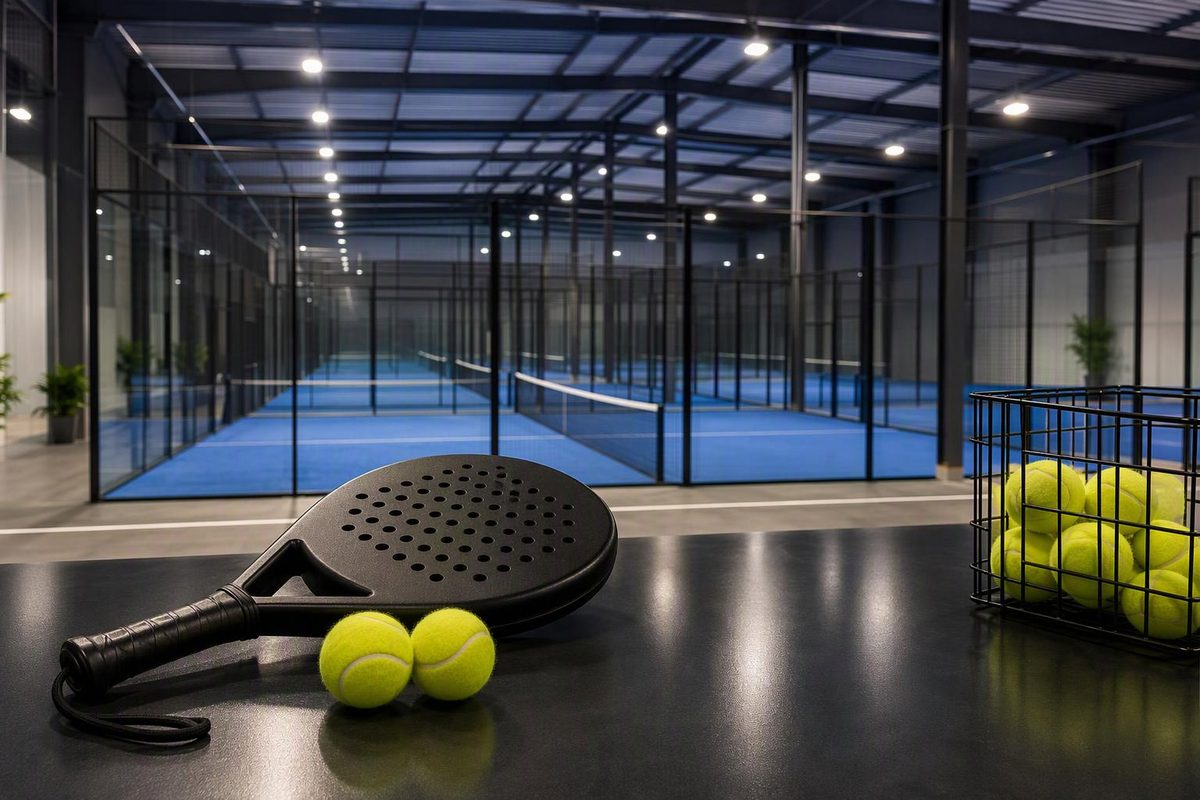
Padel Point’s planned Rosehill club has an announced capacity of 10 indoor padel courts—enough for 10 simultaneous doubles matches, or 40 players on court. This is planned playing capacity, not a building occupancy limit, a spectator allowance or confirmation that the courts are open.
As of 7 October 2026, the operator’s website still lists Rosehill as “Coming Soon”. Its September 2026 announcement targets an end-of-2026 opening for the second Sydney location, with ten indoor panoramic courts supplied by JUBO. The announced location is Rosehill, NSW 2142.
Choose how many courts are reserved for other activities; see the remaining general-booking capacity.
General Doubles Booking Capacity
Allocation scenario, not Rosehill’s timetable.
10 courts remain for general bookings.
Assumes four players on every remaining court. Players using reserved courts are not counted.
Planned supply only: Rosehill was listed as “Coming Soon” as of 7 October 2026. Total venue and spectator occupancy: —.
Sources: Padel Point’s September 2026 announcement (10 planned indoor courts); LTA beginner guide (four players per doubles court). Results are calculated scenarios.
Ten Courts Means 40 Players Only Under Full Doubles Use
The ten-court figure comes from the operator’s development announcement, rather than a completed-site inventory. It describes the physical court supply planned for Rosehill. The 40-player figure is a calculation based on that supply, not a separate attendance figure published by the operator.
Standard doubles puts four players on each court. The LTA’s beginner guide confirms that padel courts are designed for four players and that most matches are played as doubles. Applying that format to all ten announced courts gives the planned simultaneous playing capacity.
Simultaneous doubles capacity equals available courts multiplied by four players per court: 10 × 4 = 40 players.
| Capacity Measure | Rosehill Figure | What It Means |
|---|---|---|
| Announced indoor courts | 10 | Planned court supply |
| Simultaneous doubles matches | 10 | All courts available for matches |
| Simultaneous doubles players | 40 | Calculated, not an occupancy limit |
| Total venue occupancy | Not stated | Needs separate evidence |
The calculation assumes every announced court is available and occupied by a full doubles group at the same time. It does not establish how many courts will be released for public booking, whether every slot will be filled or how the operator will divide court time between activities.
A vacant court remains part of physical supply but contributes no players to actual attendance at that moment. A court being used for coaching remains part of the facility, but it may not be available for a general doubles booking. Those distinctions explain why the same venue can have ten physical courts without offering ten bookable matches throughout its operating day.
The 40-player figure also excludes spectators, staff, people waiting for their sessions and coaches outside the playing groups. Adding any of those groups would require evidence beyond the court count. The announcement does not provide a total building or spectator occupancy figure.
Rosehill Is Announced Supply, Not Confirmed Operating Supply
The status attached to the number matters as much as the number itself. As of 7 October 2026, the defensible description is 10 planned indoor courts. Describing Rosehill as an operating ten-court club would go beyond the evidence supplied by the operator’s “Coming Soon” listing and development announcement.
Ministry of Sport’s coverage also reports ten indoor courts and an anticipated late-2026 launch. That coverage describes the same project plans. It supports the announced court count, but it is not independent confirmation that construction is complete or that players can book the venue.
The operator’s end-of-2026 target and the secondary report’s late-2026 wording are opening expectations. Neither supplies a confirmed first day of play. A launch target should therefore remain separate from operating status in a court database or a player-facing venue listing.
For a count of announced developments, Rosehill contributes ten planned indoor courts. For a count restricted to courts already operating, the supplied evidence does not justify adding those ten as open courts. Keeping those categories separate prevents a development announcement from becoming an unsupported increase in current playable supply.
The same distinction applies to the calculated player figure. Rosehill’s announcement supports a potential capacity of 40 simultaneous doubles players once all ten courts are available for that use. It does not establish that 40 players can play there today, or that 40 people have already used the venue together.
Coaching And Events Reduce General-Booking Capacity
Padel Point says the facility is intended to support simultaneous matches, coaching academies, junior programmes, corporate events and larger tournaments. These are proposed uses of the same ten courts. They do not add courts to the announced total.
For a player seeking a normal doubles booking, the relevant number is the courts available for that booking category at the desired time. Courts allocated to a coaching programme or event may still be active, but they are not simultaneously available to another group.
The calculator uses one allocation input: courts reserved for other activities. It subtracts those courts from the announced ten, then multiplies the remainder by four. Every result is an illustrative full-doubles capacity, not a forecast of Rosehill’s timetable or attendance.
| Illustrative Allocation | General Courts | Doubles Players |
|---|---|---|
| No courts reserved | 10 | 40 |
| Two courts reserved | 8 | 32 |
| All courts reserved | 0 | 0 |
The two-court example means eight courts remain for general doubles bookings, allowing 32 players at once if all eight are filled. It does not mean Rosehill has announced two coaching courts, a permanent coaching zone or a particular split between lessons and public bookings.
The all-courts-reserved example means no capacity remains for general bookings during that allocation. It does not mean the building is empty. An event could be using those courts; the tool deliberately does not estimate its participants because the activity format has not been specified.
Likewise, subtracting coaching courts cannot establish total players across the venue. A lesson need not have the same participant arrangement as a standard doubles match. The calculation answers the narrower question of how many general doubles players the remaining courts could accommodate simultaneously.
That distinction is useful when comparing the development announcement with a future booking screen. A booking screen showing fewer than ten available courts would not, by itself, contradict the physical court count. Some courts could already be booked, assigned to another programme or otherwise unavailable at the selected time. The screen would show availability, not necessarily total supply.
Forty Players Is Not A Daily Attendance Estimate
Simultaneous capacity measures a moment in time. Daily playing capacity measures the use of court time across a day. Actual attendance measures people who turn up. Unique-player totals count distinct people rather than repeated appearances. Rosehill’s announced court count supplies only the first part of those calculations.
Opening hours and session lengths would help calculate theoretical daily playing capacity, but the supplied announcement does not establish those figures. Without them, there is no supported daily player total to publish. Assuming a full day of back-to-back bookings would also introduce an occupancy assumption that the announcement does not provide.
Even with a timetable, theoretical capacity would not equal actual use. Unfilled sessions would reduce attendance. People playing more than one session could appear repeatedly in session-based totals while counting only once in a unique-player measure.
For that reason, multiplying 40 by an assumed number of sessions would produce a scenario, not a measured Rosehill attendance figure. No daily throughput estimate is included here because the necessary scheduling and usage evidence is missing.
Our guide to padel peak-time occupancy explains the distinction between court supply and actual usage. For Rosehill, the immediate limit is simpler: ten announced courts establish planned supply, while future booking and usage records would be needed to describe demand or attendance.
The indoor designation also does not resolve those missing figures. It describes the proposed courts, not their opening hours, session duration, booking availability or utilisation. Likewise, the panoramic-court specification and JUBO supplier identification do not change the four-player doubles calculation.
Tournament Entries And Spectator Limits Remain Unknown
Ten courts could accommodate ten doubles matches at once if all were allocated to match play. That is not a tournament entry limit. A tournament can schedule different players across successive rounds, so its entry count depends on match duration, scheduling and player rotation rather than court count alone.
Padel Point includes larger tournaments among the proposed uses, but the supplied announcement does not give a Rosehill tournament schedule or entry cap. Publishing a participant total would therefore require assumptions not present in the source. The supported statement is that the planned facility has ten indoor courts that could be allocated to tournament play.
Spectator capacity is a separate unknown. Forty on-court doubles players tells readers nothing about the number of spectators the venue can accommodate. Nor does it establish how many people may be inside when players, staff, coaches and waiting groups are counted together.
| Quantity | Evidence Available | Publishable Result |
|---|---|---|
| Full doubles court use | Ten planned courts | 40 players at once |
| Tournament entries | No entry cap supplied | Unknown |
| Spectator capacity | No figure supplied | Unknown |
| Building occupancy | No figure supplied | Unknown |
These unknowns should remain explicit rather than being filled with the 40-player calculation. Calling that calculation “venue capacity” without qualification could lead readers to mistake a playing-format estimate for a building limit.
The most precise short description is “40 simultaneous doubles players across ten planned courts”. It preserves both the format assumption and the development status. “Capacity for 40 people” loses both qualifications and is not supported by the announcement.
The Catchment Announcement Does Not Establish Booking Access
Padel Point identifies Parramatta, the Hills District, Western Sydney, the Inner West, Sydney Olympic Park and Ryde among Rosehill’s intended catchment areas. These are areas the proposed club aims to serve, not separate court locations or additional capacity.
The announcement leaves memberships, coaching programmes and launch events for later updates. Those details may affect how players access court time, but no Rosehill-specific membership allocation or public-booking share can be calculated from the supplied information.
Before planning a visit, confirm the opening date, street address and Rosehill-specific booking availability with the operator. The locality and postcode identify the announced area; they do not replace a confirmed destination and a playable booking slot.
For development tracking, retain the count, status and source together: ten indoor courts, planned, from the operator’s September 2026 announcement, with an end-of-2026 opening target. For playing capacity, retain the assumption alongside the result: 40 players only when all ten courts are available and occupied by standard doubles groups.
Until opening is confirmed, Rosehill is a ten-court addition to announced supply—not evidence of ten more operating courts or a measured increase in local participation.