
3 min read ·
Padel ranking: who leads FIP and what the points mean
See the FIP padel ranking leaders as of 5 October 2026, how the best-22-results system works, and why the season Race is a different table.
For professional padel, the main world-ranking reference is the International Padel Federation’s FIP Ranking. It ranks individual players, with separate men’s and women’s lists—not permanent doubles partnerships.
In the edition dated 5 October 2026, Arturo Coello and Agustín Tapia share the men’s No. 1 position on 19,911 points each. Gemma Triay and Delfina Brea share women’s No. 1 on 15,951 each. These are the standings published on the official FIP ranking page, checked on 11 October 2026; they are a dated snapshot, not live match standings.
Who leads the padel ranking?
The first five players listed in each category are:
| Category | FIP rank | Player | Country shown | Points |
|---|---|---|---|---|
| Men | 1 | Arturo Coello | Spain | 19,911 |
| Men | 1 | Agustín Tapia | Argentina | 19,911 |
| Men | 3 | Alejandro Galán | Spain | 17,723 |
| Men | 3 | Federico Chingotto | Argentina | 17,723 |
| Men | 5 | Juan Lebrón | Spain | 7,770 |
| Women | 1 | Gemma Triay | Spain | 15,951 |
| Women | 1 | Delfina Brea | Argentina | 15,951 |
| Women | 3 | Beatriz González | Spain | 14,146 |
| Women | 4 | Ariana Sánchez | Spain | 13,673 |
| Women | 5 | Paula Josemaría | Spain | 13,383 |
Source: FIP Ranking, 5 October 2026. Tied positions are preserved as published: two players at No. 1 are followed by No. 3, not No. 2.
The points column matters as much as the position. Coello and Tapia each lead Galán and Chingotto by 2,188 points in this edition. That is a gap in ranking points—not a percentage difference in playing ability or a prediction of their next match.
How FIP ranking points work
FIP’s 2026 ranking procedure counts each player’s 22 best results and names Premier Padel and the CUPRA FIP Tour as contributing circuits. Points depend on both the tournament category and the round reached.
Three rules explain most changes:
- Tournament wins have different values. The 2026 scorecard awards 2,000 points for a Premier Padel Major title, 1,000 for a P1 and 600 for a P2. On the CUPRA FIP Tour, title values are 300 for Platinum, 150 for Gold, 80 for Silver and 40 for Bronze. These winner allocations are the same for men and women in the official 2026 scorecard.
- Not every result enters the total. Once a player has 22 better eligible results, a lower-scoring finish can sit outside the ranking calculation.
- Old points expire. FIP describes point defence as a continuous 52-week cycle, with automatic deletion at its end. However, its 2026 procedure also specifies special defence timing for 2025 Majors and the Barcelona Finals, so an exact calculation should follow the published schedule, rather than assuming every result disappears precisely one calendar year later.
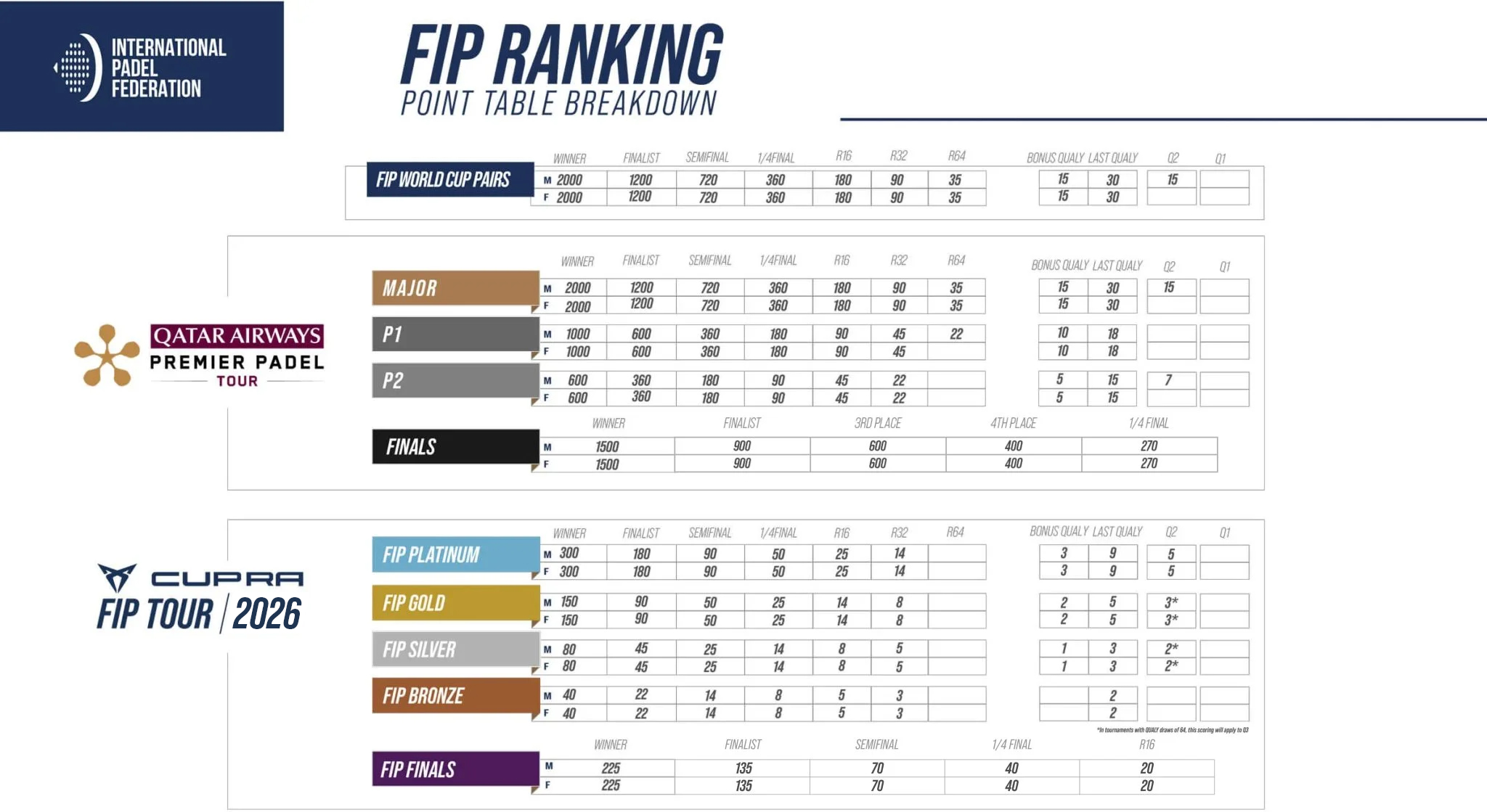
Coello’s profile provides a concrete example of the best-22 rule. His 2026 Madrid P1 quarter-final earned 180 points, but appears outside the “Best 22 tournaments” section. The result exists; it simply does not contribute to that displayed rolling total. See his official results breakdown.
FIP Ranking versus the season Race
The FIP Race Ranking answers a different question: how many points has a player accumulated from their best 22 results in the 2026 season? Unlike the rolling ranking, it does not carry qualifying results from the previous season. That distinction is set out in FIP’s Race rules.
On 5 October, Coello and Tapia each have 13,220 Race points, compared with 19,911 in the FIP Ranking. Both figures are official; they cover different periods. Compare the season Race with the rolling ranking before describing someone’s lead or recent form.
What the ranking does not measure
A FIP position measures results within its ranking system. It is not a recreational skill rating, and the number of names on a ranking list is not the number of people who play padel.
For growth research, keep ranked competitors separate from federation registrations, monthly players and annual participants. Our guide to what padel player figures count explains those distinctions. A ranking table can show who leads a competitive field; it cannot, by itself, establish the size of the sport.