
3 min read ·
The History of Padel, From Corcuera’s Court to Premier Padel
Trace padel’s history from Mexico in 1969 through Spain and Argentina, the first World Championships, professional tours and global expansion.
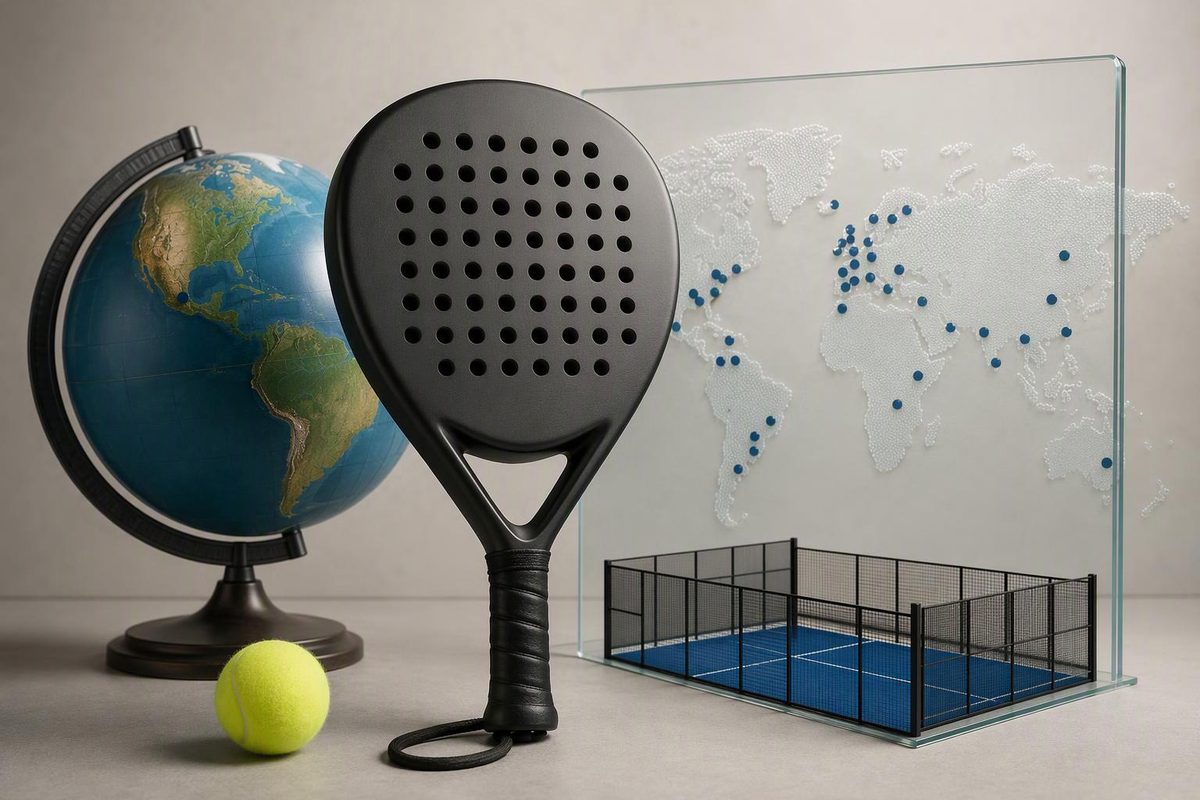
Modern padel began in Acapulco, Mexico, in 1969, when Enrique Corcuera built an enclosed court at his home. Spain and Argentina became its early centres of expansion; international governance followed in 1991, and a dedicated international professional circuit arrived in 2005. These mark different stages in the sport’s development. Source: International Padel Federation history.
1969–1980s: from Mexico to international expansion
The International Padel Federation (FIP) credits Corcuera with creating the first padel court at Las Brisas in Acapulco, and his wife, Viviana, with drafting the first rules. Alfonso de Hohenlohe subsequently brought the game to Spain, building courts at the Marbella Club. FIP places this transfer in the early 1970s; Britain’s Lawn Tennis Association (LTA) gives 1974, followed by introduction to Argentina in 1975 through an Argentine visitor to Marbella. Sources: FIP, LTA Padel.
During the 1980s, FIP records expansion into Brazil, Uruguay, Chile, France, the United States and Canada. This was the next phase of geographic spread, before the creation of an international governing body. Source: FIP.
For the first court and the route through Marbella in more detail, see padel’s origin in Mexico.
1988–2000: associations, World Championships and common rules
Padel’s next major transition was organisational. National associations, international championships and agreed rules gave a game spreading between clubs a framework for cross-border competition.
| Year | Milestone | What changed |
|---|---|---|
| 1988 | Asociación Padel Argentino founded | FIP identifies it as the first national padel association. |
| 1989 | Jorge Galeotti introduced the “Crystal Palace” glass court | A detachable, transportable court allowed the playing enclosure to be moved between locations. |
| 1991 | FIP founded in Madrid on 12 July | The Argentine, Spanish and Uruguayan associations established an international governing body. |
| 1992 | First World Padel Championships in Madrid and Seville | National teams competed for world titles. |
| 1997 | Spain and Argentina agreed to unify rules in Barcelona | The agreement also standardised the name “Padel”; Argentina had used “Paddle”. |
| 2000 | First World Junior Championship in La Plata, Argentina | International championship competition extended to juniors. |
Sources: FIP’s historical chronology and World Championships roll of honour.
Argentina won both the men’s and women’s national-team titles at the inaugural 1992 championships, with Spain taking silver and Uruguay bronze in each competition. The official results show the early competitive strength of the countries involved in founding FIP. Source: FIP roll of honour.
2005–2024: the development of professional tours
Padel Pro Tour launched in 2005, organised privately, and ran for eight seasons. World Padel Tour replaced it in 2013 and operated through 2023. These tour milestones should not be confused with the first World Championships: international championship competition preceded the dedicated international professional circuit by more than a decade. Source: FIP.
Premier Padel launched in 2022, initially alongside World Padel Tour. On 24 August 2023, Qatar Sports Investments (QSI) and Damm announced an agreement for QSI to acquire World Padel Tour’s business assets and unify the two competitions under the Premier Padel name and FIP governance. Their announcement said the separate tours would continue for the rest of 2023, with unification starting in 2024. Premier Padel’s subsequent calendar announcement identified 2024 as the first season of the unified tour. Sources: QSI’s acquisition announcement, Premier Padel’s 2024 announcement.
That was a consolidation of two leading professional tours—not the disappearance of every other padel competition. FIP’s competition structure also includes the CUPRA FIP Tour and dedicated youth and amateur circuits. Source: Premier Padel’s governance overview.
What the expansion records actually measure
FIP’s chronology records 11 national federations by the end of the 1990s and more than 40 affiliated federations by the end of the 2010s. As checked in October 2026, it reports 100 affiliated federations. That documents a wider organised presence, but federation membership is not a count of players, courts or clubs. Source: FIP.
Similarly, Premier Padel’s published 2026 season features 25 tournaments across 17 countries. That describes the tour’s calendar footprint, not participation in those markets or spectator demand. Source: Premier Padel.
Measuring how many people now play requires different evidence: see global padel participation estimates and their limitations.